Enterprise AI Intelligence Layer
A live, governed decision-support system for Brooklyn Nets ticketing — built on ChatGPT Actions, AWS, FastAPI, and Snowflake, with Snowflake Cortex Search powering semantic retrieval. Designed and productionized with the Neural Nets team, spanning architecture, data modeling, API evolution, and production stabilization.
BKSE Game Insights Agent
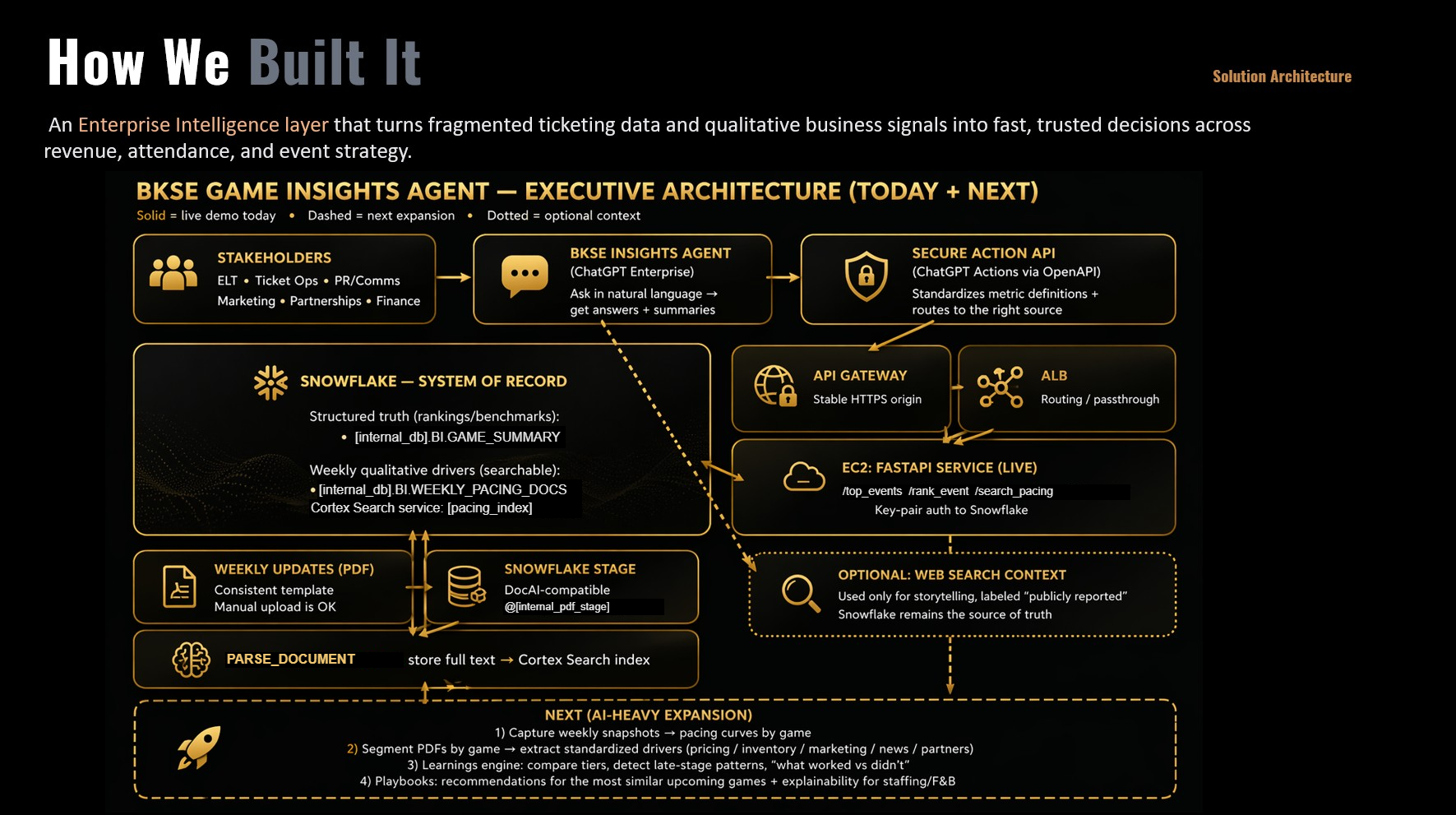
↔ Scroll horizontally on narrow viewports for full labels.
Faster, more reliable answers
Leaders needed faster, more reliable answers that combined governed KPIs, weekly pacing drivers, and unstructured business context — without waiting for ad-hoc analyst pulls or piecing together fragmented sales, attendance, and pacing reports.
Before this work, the data lived in three places and three shapes: structured event metrics in Snowflake, qualitative business signals in weekly PDFs, and historical context spread across past decks. Answering an executive question usually meant chasing all three, then assembling a synthesis by hand. That gap between question and answer was where decisions slowed down.
Built across four pillars
As part of the Neural Nets team, I helped design and productionize an enterprise intelligence layer for Brooklyn Nets ticketing — a live, governed decision-support system on ChatGPT Actions, AWS (API Gateway, ALB, EC2), FastAPI, and Snowflake, with Snowflake Cortex Search powering semantic retrieval and AI document parsing handling unstructured PDFs.
My contribution spanned architecture, data modeling, API evolution, production stabilization, and product framing — moving the project from scattered handovers and manual workflows into a functioning AI interface that answers revenue, attendance, ranking, and pacing questions in natural language.
End-to-end architecture
Helped shape the system from ChatGPT Actions through the Secure Action API to the FastAPI service, API Gateway, and ALB — with Snowflake as the structured source of truth and weekly business reports adding qualitative context through Cortex Search.
Semantic foundation, expanded safely
Expanded the modeled data layer from a narrow 85×23 source into a richer 128×179 event-intelligence schema, while preserving the stable BKSE_SUMMARY object through a safe cutover so downstream applications kept working without disruption.
API evolution: fixed → dynamic
Evolved the API from a fixed-metric design to validated dynamic metric retrieval with standardized definitions and routed sources. Working endpoints cover metrics, rankings, top events, and weekly pacing search — the four shapes leaders actually ask for.
Production stabilization
Resolved live blockers across backend logic, deployment, and Snowflake runtime — query bugs, deployment conflicts, and warehouse-access issues — to produce a healthy live API and validated hybrid behavior that combines structured truth with qualitative narrative.
By the numbers
From over an hour of manual work to a roughly five-minute workflow.
Questions that used to take half a workday now resolve in under thirty minutes.
Expanded the modeled data layer from a narrow source into a richer event-intelligence schema.
Unified semantic foundation spanning five years of ticketing history.
Source-aware answers, in natural language
Executives get grounded, source-aware answers in natural language — blending structured KPIs with weekly pacing drivers and qualitative business context. The same interface answers four shapes of question that previously each required a different workflow.
- Metrics"What were our weekly ticket-sales tier outcomes for the last home stand?"
- Rankings"How did Friday's game compare to the same matchup over the last three seasons?"
- Top events"Which five events outperformed pacing the most in Q3?"
- Pacing drivers"What qualitative factors drove the pacing shift on the Lakers game?"
A reusable foundation, not a one-off chatbot
The point of this work was not to ship a demo. It was to establish a governed intelligence layer that can carry future workloads without rebuilding the data plane underneath.
With a unified semantic foundation, a stable production object, and a validated dynamic API in place, the same backend now supports a clear path forward: forecasting services that learn from prior pacing curves, prescriptive recommendations for the most similar upcoming games, qualitative driver normalization across pricing, inventory, marketing, and news, and broader internal access channels beyond the executive chat surface.
Translation: the next features ship on top of this layer — not around it.